Rules of Competitive Karuta
The rules below follow the standards of the All Japan Karuta Association (全日本かるた協会). Matches are one-on-one, with a neutral reciter and a fixed layout of cards. This rule summary is based on the Saitama Prefecture Karuta Association's handbook. For full rules, see the official rules (Japanese) page.
One match uses only 50 of the 100 playing cards. Each player has 25 cards in their territory. The other 50 cards are not used in that game (they are called Kara-fuda, 空札).
I. Arrangement and Memorization
- Sit facing each other across the cards. Bow and say “Yoroshiku onegai shimasu” (“Do our best” / “Good game to each other”).
- All 100 playing cards are placed face down and mixed well. Each player picks 25 cards without looking at the faces. Your 25 cards are your Mochi-fuda (持ち札, your share). Only these 50 cards are in play for this match.
- Arrange your Mochi-fuda in three rows on the tatami in front of you, according to the official layout (spacing and positions are specified by the association).
- Memorization time: 15 minutes. Memorize the placement of your cards and the opponent’s cards. After 13 minutes, you may practice reaching quickly for cards but must not touch them yet.
- Bow to each other again with “Yoroshiku onegai shimasu”, then bow to the reciter. The game then begins.
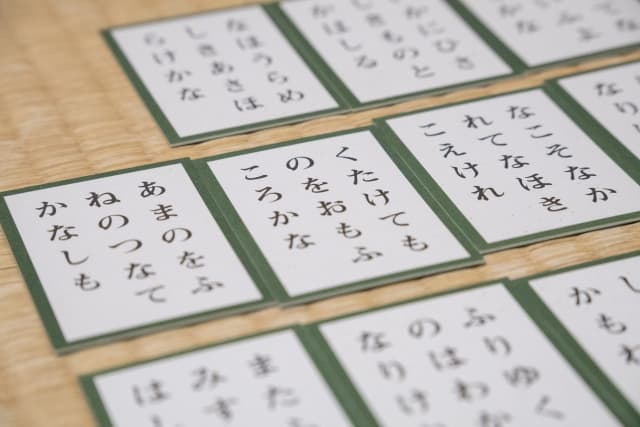
II. Start of the Game — How to Take a Card
Joka (Introduction poem)
The reciter first reads a poem that is not in the Ogura Hyakunin Isshu. This is the Joka (序歌), an introduction to the game. The reciter reads Kami-no-ku → Shimo-no-ku → Shimo-no-ku of the Joka, then after a one-second pause begins the first poem of the match (chosen randomly from the 100 reading cards). The All Japan Karuta Association currently uses the poem beginning “Naniwazu ni…” as the Joka.
Reading order
For each card after the first, the reciter reads the Shimo-no-ku (second half) of the previous card, then after a one-second pause reads the Kami-no-ku (first half) of the next card. So players hear the lower phrase of the last poem, then the upper phrase of the new one.
Taking a card
The card that matches the poem being read is called the De-fuda (出札). When the De-fuda is in either territory, the two players compete to take it. There are two valid ways to take a card:
- Touch the correct card first — the first player to touch the matching card takes it.
- Cards-pushing way (Fuda-oshi / Harai-te) — swipe the matching card (and sometimes nearby cards) out of the Kyogi-sen (競技線, the playing area) faster than the opponent.
If the matching card is not in either territory (it is one of the 50 Kara-fuda, 空札, not used in this game), wait until the next poem is read.
After taking a card
- The player who took the card places it face down beside them.
- If the card was in your territory (Jijin): the number of cards in your territory goes down by one.
- If the card was in the opponent’s territory (Tekijin): you give one card from your own territory to the opponent. The opponent places this Okuri-fuda (送り札) in their preferred row. The total number of cards in the opponent’s territory stays the same.
- After rearranging any cards that were swiped, the next poem is read. While rearranging, the player should raise one arm straight up to tell the reciter to wait.
III. Winning the Game
The game continues until one player’s territory has no cards left. The winner is the player whose territory reaches 0 cards first. When the game is over, the two players bow to each other, then bow to the reciter.
Important: You win by being the first to have 0 cards in your territory — not by taking the most cards overall. If you commit many fouls (Otetsuki), you give cards to the opponent, so you may lose even if you took more cards than they did.
IV. Fouls (Otetsuki)
If a player touches any card in the territory that does not have the recited poem (i.e. the wrong card or cards), it is a foul (Otetsuki, お手つき).
Penalty: The player who committed the foul receives one card from the opponent’s territory. The opponent gives one of their cards to the faulting player, who places it in their own territory.
If you take a card using the opposite hand from the one you normally use for the game, it is not counted as a foul, but it is considered an obstruction. The card is regarded as taken by your opponent.